

The hurricane prep step most people skip: How to make a hurricane home inventory and protect your claim
A home inventory is a detailed record — through photos, videos, and documentation — of your belongings and their value. It's one of the most important parts of hurricane preparation, because it's what ensures you get fully reimbursed for everything lost in a storm. Without one, you risk underestimating your losses and slowing down your homeowners insurance claim. To create one, photograph your possessions, save proof of value, and store the records somewhere safe.
Water, batteries, plywood — many people stock up on these essentials during hurricane season, but they skip the home inventory list. Only 47% of homeowners have a home inventory, according to the most recent data from Triple-I/Munich Re's 2023 Q2 Consumer Survey.
Relying on your memory means you could underestimate your losses, and it could also slow down reimbursement.
“An inventory will help speed up the insurance claims process,” says Tim Singnysane, director of operations for 1-800 WATER DAMAGE and Blue Kangaroo Packoutz, which offer cleaning and restoration services.
In this guide, Insure.com shows you how to make a hurricane home inventory.
How to build your home inventory in one hour
Don't have a home inventory yet? You can put a basic one together this weekend with just your phone and dramatically strengthen a potential claim.
- Record a video of every room. Walk slowly, narrate as you go, and open every closet, cabinet, and drawer.
- Photograph high-value items up close. Capture serial numbers, brand labels, and any receipts in the same shot.
- Save it in two places. Upload to the cloud (e.g., Google Drive, iCloud, Dropbox) and keep one more copy somewhere else, like email or an external drive.
Hurricane prep checklist: Everything in one place
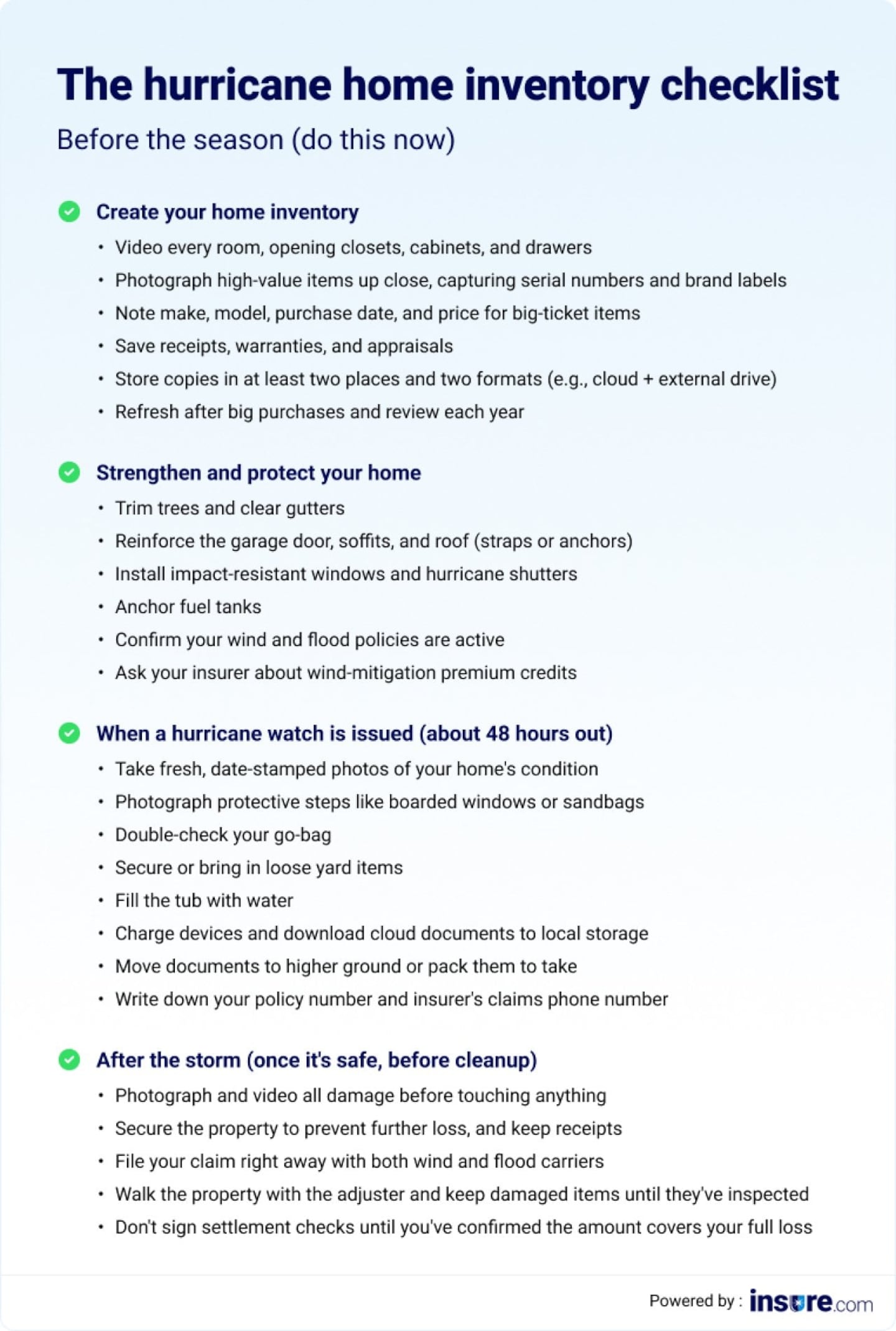
Here's the full hurricane home inventory and prep checklist, organized by when to do each task — before the season, when a watch is issued, and after the storm. Save or print it, then read on for the details behind each step.
Insure.com
How do you prepare your home for a hurricane?
Preparing your home for a hurricane comes down to stopping wind from getting inside and keeping the structure intact. The biggest risks are a breached opening — like a failed garage door or window — and flying debris, so most effective prep targets those weak points. Making these mitigation upgrades reduces storm damage and can also lower your insurance premiums.
Here are some ways to minimize hurricane damage to your home:
- Trim trees
- Clear gutters and reinforce soffits
- Strengthen the garage door
- Install impact-resistant windows and hurricane shutters
- Add hurricane anchors or straps to the roof
- Anchor fuel tanks
Once you make these updates, you may be eligible for hurricane mitigation credits on your premiums. For instance, Florida law requires insurers to offer discounts to homeowners who make wind mitigation upgrades. To qualify, you'll need an inspection by a licensed inspector, who completes a form that's submitted to your insurer.
Strengthening your home reduces what you'll lose. Documenting it determines what you'll recover.
What to photograph for a home inventory
Photograph every room and the full exterior of your home, then capture high-value items individually. Photos are the fastest way to document your home's condition and contents before a storm — and the easiest proof to share with your insurer afterward.
“I would definitely take photos and videos of each room,” Singnysane says.
Here’s what to cover:
Exterior
- Each side of the house
- Roof
- Soffits and gutters
- Decks, porches and other outdoor living spaces
- Fences
- Landscaping
- Accessory buildings
Interior
- Wide shots of each room
- Close-ups of each section of each room
- Inside closets, cabinets and drawers
- Garage
- Attic
- Other storage areas, including those off-site
Then, take photos of high-value items individually. These items may include jewelry, art, electronics, tools and appliances.
Record a video walkthrough as well, narrating notable items and features as you go. Video captures context a photo can't, like a room's full layout or the contents of a packed closet in one pass.
What to record for high-value items
For high-value items, your inventory needs to identify the item and prove its value. That way, you can get its full value if it's damaged. You should also include the following in your inventory:
- Description of item, including make, model, purchase date, and purchase price
- Receipts, warranties, and appraisals
Check with your insurer to see what documentation they require. Some want more than one piece of evidence for certain items. For instance, a photo of your big screen TV may not be enough to establish its value. The insurance company may also want to see a receipt.
For items with multiples, such as clothing, make a note of how many you have in each category, such as shoes, jeans or dresses.
Kelly Nash, president of private risk management for The Baldwin Group, recommends taking photos of all important documents and then storing physical copies together in a secure box that can be easily moved to a safe location if and when a storm arrives.
Where to store your inventory so the storm doesn't destroy it too
Now that you have your home inventory, you need to know where to keep it.
“I would prefer you to have multiple locations,” Singnysane says.
Use two or more of the following options to make sure you can access your home inventory when it’s needed:
- Upload to cloud storage such as Google Drive, iCloud, OneDrive or Dropbox.
- Email a copy to yourself and save it in a clearly identified folder.
- Place in a fireproof and waterproof box stored at a high location in your home.
- Rent a safe deposit box at a bank.
- Keep a copy at a trusted relative's house.
- Use a home inventory app such as NAIC Home Inventory, Sortly or Nest Egg.
In addition to storing multiple copies of your home inventory, keep it in multiple formats. For instance, you may upload it to the cloud, keep a physical copy in a safe at your house and save an extra copy on an external hard drive at a relative’s house.
How to build an emergency kit and a family plan
Anyone in a hurricane's reach — not just its direct path — needs both a go-bag and emergency supplies for home. Storm surge and flooding can affect areas miles from where the storm makes landfall.
The go-bag should have essentials for three days, while people should be prepared for up to two weeks without power at home, Nash advises.
“If you are without power for that long, how are you going to communicate?” she asks. Her recommendation is to have a solar-powered phone charger and a battery-powered or hand-cranked radio.
Stock up on water — one gallon per person per day is recommended — and make sure you have enough non-perishable food, pet food, infant formula and medications to last during an extended period without electricity.
The go-bag should include medications, pet food, infant formula, a change of clothes, nonperishable food, a flashlight, a first-aid kit, small toys for children, and cash.
What should be on your hurricane evacuation checklist?
- Have a go-bag packed and ready in advance.
- Keep a written list of emergency numbers.
- Identify an out-of-town contact for family members to check in with.
- Decide on a family meeting place if separated.
- Know your evacuation route in advance.
- Sign up for local emergency alerts and download the FEMA app and Red Cross emergency app.
Have an evacuation plan
Sometimes, extreme weather situations require residents to evacuate their homes by choice or government order. A few preparations in advance can make this process much easier.
- Identify evacuation zones: Before a storm, local officials will determine evacuation zones based on the likelihood that an area will flood due to the storm surge, or projected rise in sea level from a hurricane. Know what zone you live in and monitor local news to stay up to date in case you need to evacuate.
- Find local shelters: You should also find out where the closest public emergency shelters are located. You can check the FEMA app for a list of current shelters or text the word "SHELTER" and your ZIP code to 43362. The Red Cross website also lists currently open shelters. Different shelters have different requirements. For example, if you have a pet, make sure the shelter allows animals.
- Establish transportation plans: Hurricanes can result in road closures and create transit obstacles. Make sure you have an established evacuation route in mind before the storm and monitor local news during the storm for updates on road conditions.
- Create a family plan: Does your workplace have a disaster plan? Does your child's school have a plan? Will they shelter in place? Disasters can strike when your family members are not with you. Find out what plans are in place for other locations.
“Have an evacuation plan and knowledge of local evacuation routes and shelters,” says Christie Alderman, vice president of product innovation and development at Chubb Insurance. “Prepare medicines, important information, and phone numbers, including your insurance information, and fill your car with gas.”
What to do when a hurricane watch is issued
In the two days before a hurricane, document your home's pre-storm condition, secure your property, and protect your important documents and devices. The National Weather Service issues hurricane watches 48 hours before storm-force winds are possible, and this is your cue to prepare your property.
- Take new exterior and interior photos to show the condition of your home before the storm. Make sure these photos are date-stamped.
- Photograph any protective measures you take, such as boarded windows or sandbags — some policies require this proof.
- Double-check the contents of your go-bag.
- Strap down or remove any loose items from your yard, such as patio furniture.
- Fill your tub with water that can be used to flush toilets.
- Charge phones and other devices and download important cloud documents to local storage on your device.
Move documents to a higher level of your home or keep them ready to grab if you evacuate. Write down your insurance policy number and your insurer's claims phone number, too. Nash says The Baldwin Group proactively sends this information to customers in a storm's path, but you may need to contact your insurer or find it in your online account.
What to do right after a hurricane and before cleanup
Once it's safe, document the damage with photos and videos, secure your property to prevent further loss, and file your insurance claim as soon as possible — before you start any cleanup. Acting in that order protects both your safety and your claim.
- Take photographs and videos of everything.
- Secure your property to prevent further damage, such as boarding broken windows or covering the roof with a tarp. Take photos of this as well and keep your receipts.
- Call your insurer to file a claim.
How do you file a hurricane insurance claim?
Don’t wait to contact your insurer. Companies typically process claims in the order received.
“You want to get into that queue as quickly as possible,” Nash says. Go ahead and file with both your wind and flood insurance carriers. They will sort out what each covers.
When an adjuster comes for an inspection, walk the property with them. If you have started clean-up before, don’t throw anything away. For instance, if you rip out carpet, set it aside. The adjuster will likely want to see it. If you think the adjuster missed anything during their visit, follow up with them in writing.
Finally, be cautious about signing settlement checks or cashing payments until you've confirmed the amount covers your full loss.
Common home inventory mistakes that shrink your payout
The costliest documentation mistakes share one trait — they leave you unable to prove what you owned or what it was worth. Here are the ones to watch for.
- Only photographing rooms or rushing through closet contents. "Open all your cabinets and drawers and slow down," Nash advises, so your video clearly shows everything you own.
- Not recording serial numbers for electronics and appliances.
- Guessing at an item's value instead of keeping receipts.
- Keeping only one copy of your home inventory.
- Failing to update your inventory after a big purchase.
- Cleaning up before documenting the damage.
- Throwing things away before the adjuster visits.
An hour this weekend could pay off for years
Most hurricane prep protects your home. A home inventory protects what's inside it, and it's the step that determines how much you actually recover when you file a claim. All it takes is your phone, a cloud folder, and an hour to walk through your house room by room, capturing what you own and what it's worth.
Do it once and you've got a record that pays off for years. Just refresh it after big purchases and check it each year as hurricane season approaches. With this season already underway, the best time to start is now, before a storm is ever on the radar.
Frequently Asked Questions: Hurricane Preparation
What will your insurer ask for after a hurricane?
Insurers will want to see proof of which items you owned and how much each is worth. Photographs and videos can document your possessions, but to confirm value, an insurance company may request receipts or appraisals, particularly for valuable items.
Do I need serial numbers for an insurance claim?
Not necessarily. A serial number is the best way to prove ownership and value, but without one, you can still file a claim using different documentation, such as a receipt.
How should I store my home inventory?
You should store your home inventory in a place that is both safe and accessible. Cloud storage, an external hard drive kept in a safe deposit box, or a paper version in a safe are all options. Ideally, you should have multiple copies of your inventory, each stored using a different method.
What if I didn't take photos before the hurricane?
You can still file a claim with your insurance company and receive reimbursement. However, your reimbursement may be lower if you can’t prove the condition of your house or the possessions you owned prior to the storm. Going back through old photos on your phone or searching for emailed receipts may help fill in some of these gaps.
How long do I have to file a hurricane insurance claim?
It depends on your state's laws, so check the rules where you live. In Florida, you have one year from the date of loss to file a new or reopened property insurance claim, with the clock starting on the date the hurricane made landfall, as verified by NOAA — not the day you discover the damage. If you find additional damage later, Florida gives you up to 18 months from the loss date to file a supplemental claim. Either way, the smarter move is to file as soon as it's safe rather than waiting, since hidden damage like mold or roof leaks can surface months after a storm.
This story was produced by Insure.com and reviewed and distributed by Stacker.


