JACKSONVILLE, Fla. — To become a part of the First Alert Neighborhood weather station network powered by Tempest - scan below &/or click * here *:

Updated every day throughout the hurricane season - “Talking the Tropics With Mike”.
And the tropics are ending the month of October (continues through Nov. 30) with a powerful hurricane as Melissa came ashore about mid-day Tue., Oct. 28th on the southwest coast of Jamaica near New Hope with Black Village taking an extremely hard hit within the violent eastern eyewall of the Cat. 5 hurricane.
- Maximum sustained winds of 185 mph, with gusts >200 mph
- Minimum pressure of 892 millibars (26.34″ of mercury)
- Tied for second strongest Atlantic hurricane in regard to winds
- Tied for third most intense Atlantic hurricane in regard to pressure
- The storm has been a Category 5 hurricane for more than 30 consecutive hours
- Tied with Dorian (2019) and Labor Day (1935) as the strongest hurricane to make landfall in the Atlantic with 185 mph winds
- Melissa is the 3rd Category 5 hurricane of 2025, the second most ever in an Atlantic season behind 4 Cat. 5’s in 2005 (Emily, Katrina, Rita, Wilma)


Microwave satellite imagery from CIMSS (Cooperative Institute for Meteorological Satellite Studies) as Melissa’s eye tightened upon approach to Jamaica:

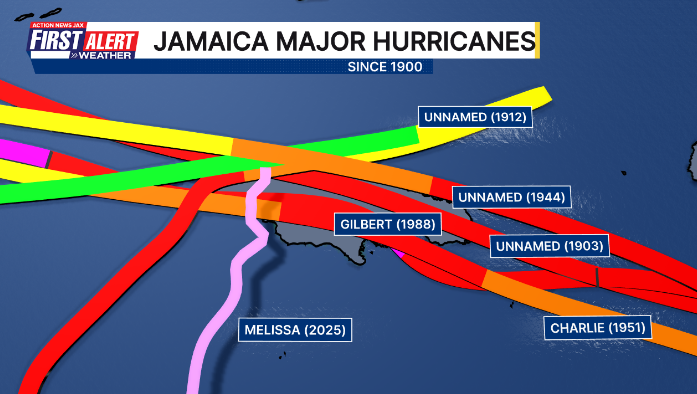
Melissa was the first Cat. 5 hurricane to make a direct landfall on the island nation & only the 2nd “major” hurricane to hit Jamaica from the south (the other one was in 1912):

NEW: Devastating imagery from Jamaica, before & after Category 5 Hurricane Melissa.
— Nahel Belgherze (@WxNB_) October 29, 2025
White House — Landfall point. pic.twitter.com/SUiQrOjnIb
This looks like the pictures you see in the Deep South with an EF4 tornado. Extremely high-end hurricane wind damage from #Melissa. https://t.co/jmnX82WhkA
— Andy Hazelton (@AndyHazelton) October 29, 2025
A look at the devastating power loss across Jamaica following the historic crossing of Hurricane Melissa, captured by NOAA-21. pic.twitter.com/9xg6HavjmV
— CIRA (@CIRA_CSU) October 30, 2025
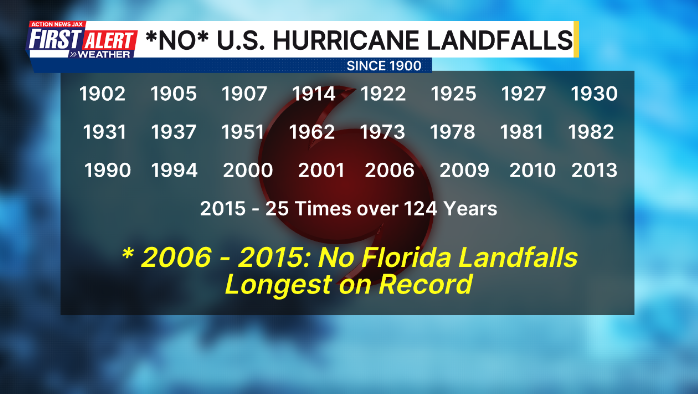
And while on the topic of hurricanes... the U.S. has not had a hurricane landfall this season *so far* which - since 1900 - happens only about once every 4-5 years. But Florida did go a record 10 years from 2006-2015 without a single hurricane landfall.
But the 2025 Atlantic hurricane season certainly has not been what one would term “quiet” with 3(!) Cat. 5 hurricanes which hasn’t happened since there were 4(!) Cat. 5’s in 2005 (Emily, Katrina, Rita & Wilma - only Emily did not directly impact the U.S.).
The three Category 5 storms of the 2025 Atlantic hurricane season. pic.twitter.com/BcAotaeouB
— CIRA (@CIRA_CSU) October 30, 2025
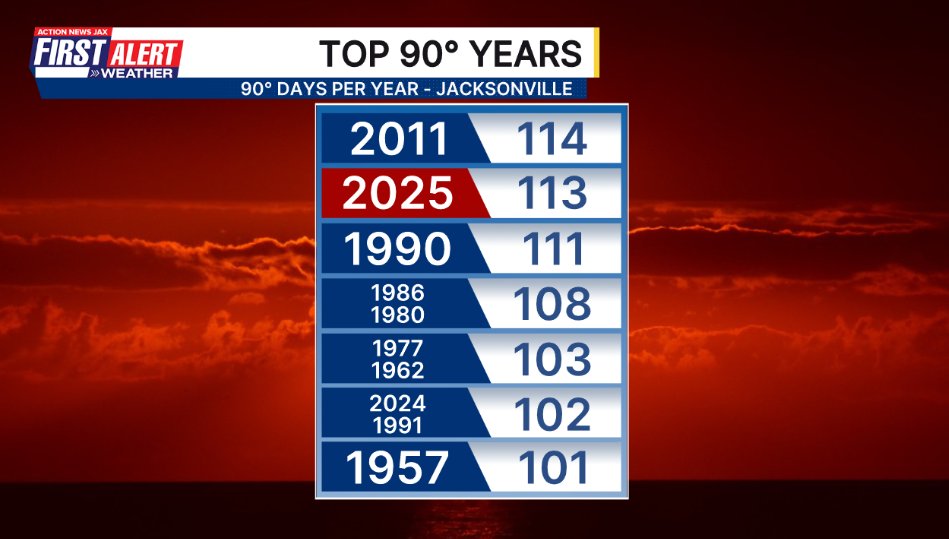
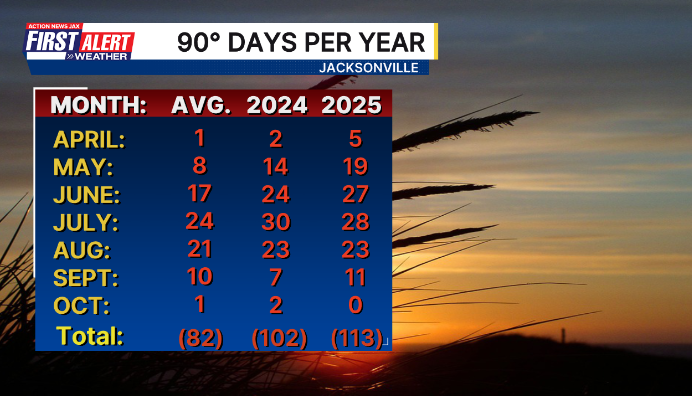
Never has Jacksonville, Florida had an official 90-degree day in Nov. or Dec., so it looks like we’ll end the year with 113 90-degree days just 1 days short of the all-time record of 114 90-degree days in 2011. The average for a year is 82 90-degree days in Jacksonville.
So it’s time to turn the calendars to November:
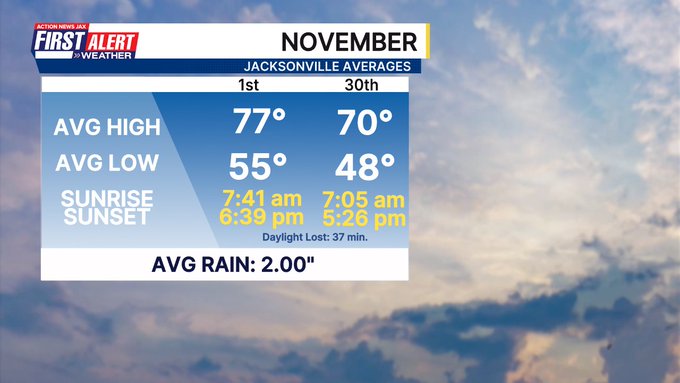
And since we fall back one hour Sunday (Nov. 2) - sunrise will be at 6:42am, sunset at 5:38pm(!) - keep in mind that residential customers are expected to cut back irrigation to once per week which is very realistic since days are shorter & temps. are much cooler.
From the St. Johns River Water District:
With cooler weather and shorter days, lawns and landscapes naturally require less water. Cutting back irrigation this time of year helps conserve the groundwater that supplies our homes and sustains our rivers, lakes and coastal estuaries that define the Lower St. Johns River Basin. From Crescent Lake to the tidal reaches of the St. Johns River, these waters reflect our connection to the aquifer below, the same source that provides our drinking water and sustains the ecosystems that make this region distinct.
“Conserving water is one of the most direct ways we can protect our aquifers, springs and water supplies in North Florida,” said St. Johns River Water Management District Water Conservation Coordinator Kraig McLane. “By following seasonal watering restrictions, we help preserve these vital resources for both people and the environment.”
Public water supply is the District’s largest use, with residents and businesses together using hundreds of millions of gallons of water each day. Outdoor irrigation accounts for much of that demand. Adjusting watering schedules with the seasons helps balance this use, supporting both healthy landscapes and a sustainable water supply.
Once-a-week watering schedule (effective Nov. 2, 2025, through March 8, 2026):
- Homes with odd-numbered or no addresses: Saturday.
- Homes with even-numbered addresses: Sunday.
- Nonresidential properties: Tuesday.
- Watering hours: Prohibited between 10 a.m. and 4 p.m. to reduce evaporation.
- Watering time: Limited to one hour per zone.
- Applies to: All water sources, including wells, surface water, and utilities.
For many newcomers to Florida, it can be surprising to see lawns turn brown during the winter months. However, this seasonal change is normal. Most warm-weather grasses, such as St. Augustine and Bahia, go dormant when temperatures drop. Dormancy doesn’t mean the grass is dead; it’s simply resting until warmer weather returns. Overwatering during this period can waste water and lead to root rot, mold or other lawn health issues.
Additional conservation tips:
- Calibrate irrigation timers to match the current watering schedule.
- Inspect sprinkler systems for leaks or misdirected spray.
- Use a rain sensor or smart irrigation controller to automatically pause watering when it rains.
- Consider replacing high-volume spray heads with more efficient rotary nozzles.
Small changes in irrigation habits can make a big difference in protecting Florida’s water resources. By watering only when necessary, residents help preserve the region’s springs, rivers and aquifers — the sources that sustain our communities and natural environment.