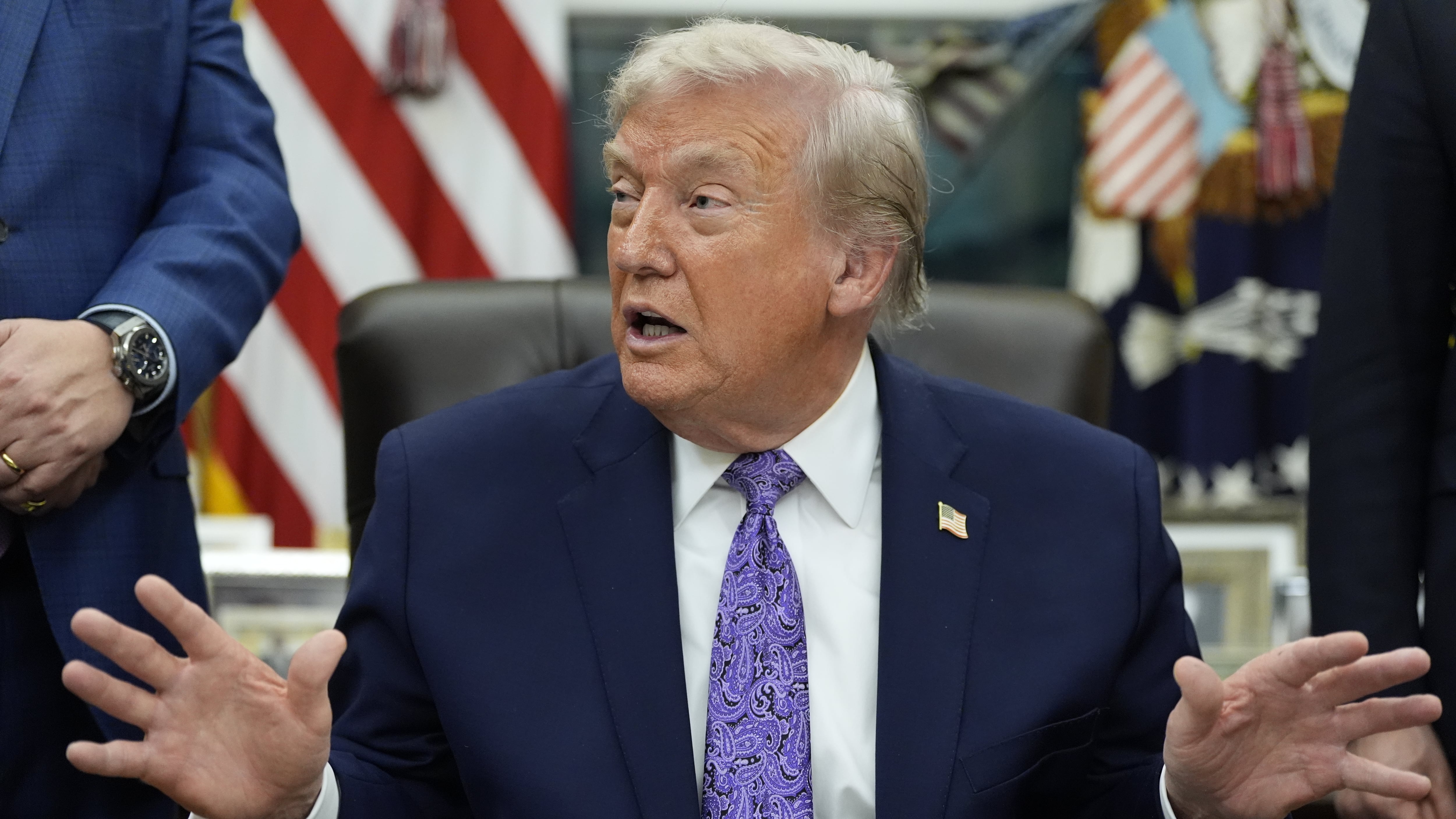
WASHINGTON — President Donald Trump said Friday that Thai and Cambodian leaders had agreed to renew a truce after days of deadly clashes, even as Thai and Cambodian officials suggested there is still work to do to get the ceasefire that the U.S. administration had helped broker earlier this year back on track.
Trump announced the agreement to restart the ceasefire in a social media posting following calls with Thai Prime Minister Anutin Charnvirakul and Cambodian Prime Minister Hun Manet.
“They have agreed to CEASE all shooting effective this evening, and go back to the original Peace Accord made with me, and them, with the help of the Great Prime Minister of Malaysia, Anwar Ibrahim,” Trump said in his Truth Social post.
The Thai Ministry of Foreign Affairs on Saturday disputed Trump’s assertion that a ceasefire was agreed to without providing any details, and Thai defense ministry spokesperson Surasant Kongsiri said clashes were still ongoing. Cambodia’s defense ministry reported that Thailand continued to carry out strikes early Saturday. Those strikes could not be independently verified.
Thai prime minister differs with Trump
After speaking with Trump on Friday but before the U.S. president's social media posting, Anutin said he reiterated to Trump that Thailand's position was to keep fighting until Cambodia no longer posed a threat to its sovereignty.
“I told him that he had better talk to our friend. Don’t just say that we have to stop fighting," Anutin said. "You should announce to the world that Cambodia will stop firing, will withdraw their forces, will clear all land mines. Please show us the actions.”
Trump wrote in his Friday social media post, “The roadside bomb that originally killed and wounded numerous Thai Soldiers was an accident, but Thailand nevertheless retaliated very strongly."
The comment was an apparent reference to recent land mine explosions along the border that triggered tensions between the two countries.
The Thai army reported multiple injuries from the explosions but no deaths and Anutin on Saturday refuted Trump's characterization.
“It’s definitely not a roadside accident," Anutin said Saturday morning on his Facebook account. "Thailand will continue to perform military actions until we feel no more harm and threats to our land and people. I want to make it clear. Our actions this morning already spoke.”
Trump, a Republican, said Malaysia's prime minister had played an important role in helping him push Thailand and Cambodia to once again agree to "resolving what could have evolved into a major War between two otherwise wonderful and prosperous Countries!”
The original ceasefire in July was brokered by Malaysia and pushed through by pressure from Trump, who threatened to withhold trade privileges unless Thailand and Cambodia agreed. It was formalized in more detail in October at a regional meeting in Malaysia that Trump attended.
Despite the deal, the two countries carried on a bitter propaganda war and minor cross-border violence continued.
Conflict has a long history
The roots of the Thai-Cambodian border conflict lie in a history of enmity over competing territorial claims. These claims largely stem from a 1907 map created while Cambodia was under French colonial rule, which Thailand maintains is inaccurate. Tensions were exacerbated by a 1962 International Court of Justice ruling that awarded sovereignty to Cambodia, which still riles many Thais.
Thailand has deployed jet fighters to carry out airstrikes on what it says are military targets. Cambodia has deployed BM-21 rocket launchers with a range of 30-40 kilometers (19-25 miles).
According to data collected by public broadcaster ThaiPBS, at least six of the Thai soldiers who were killed were hit by rocket shrapnel.
The Thai army’s northeastern regional command said Thursday that some residential areas and homes near the border were damaged by BM-21 rocket launchers from Cambodian forces.
The Thai army also said it destroyed a tall crane atop a hill held by Cambodia where the centuries-old Preah Vihear temple is located, because it allegedly held electronic and optical devices used for military command and control purposes.
Trump has repeatedly made the exaggerated claim that he has helped solve eight conflicts, including the one between Thailand and Cambodia, since returning to office in January, as evidence of his negotiating prowess. And he's not been shy about his desire to be recognized with a Nobel Peace Prize.
In an exchange with reporters later Friday, Trump credited his administration with doing a “a very good job” with its push to stem the renewed fighting.
“And we got it, I think, straightened out today,” Trump said at an unrelated event in the Oval Office. “So Thailand and Cambodia is in good shape.”
African and Middle East agreements also under strain
Another ceasefire that Trump takes credit for working out, between the Democratic Republic of Congo and Rwanda, is also under strain, just after the leaders of the African nations traveled to Washington to sign a peace deal.
A joint statement released by the International Contact Group for the Great Lakes expressed "profound concern" over the situation in Congo's South Kivu region, where new deadly violence blamed on the Rwandan-backed M23 militia group has exploded in recent days.
The Great Lakes contact group — which includes Belgium, Britain, Denmark, France, Germany, the Netherlands, Sweden, Switzerland, the United States and the European Union — has urged all sides “to uphold their commitments” under the deal signed last week and “immediately de-escalate the situation.”
And Trump's internationally endorsed plan to end the Israel-Hamas war in Gaza is still not finalized and in limbo, with sporadic fighting continuing while a critical second phase remains a work in progress.
___
AP writer Jintamas Saksornchai reported from Surin, Thailand. Grant Peck in Bangkok and Matthew Lee contributed reporting.
Copyright 2025 The Associated Press. All rights reserved. This material may not be published, broadcast, rewritten or redistributed without permission.


